This post may contain affiliate links. If you choose to purchase through them, I may earn a small commission at no extra cost to you. It truly helps support Restful Roots Life—thank you.
Hi, I’m Jen—mom of twins and the voice behind Restful Roots Life. If this is your first time here, welcome. If you’ve been here before, I see you, and I’m so glad you’re back!
If you’ve ever wondered how to handle toddler tantrums without yelling, shame, or power struggles, you’re not alone. We started the grocery trip so well.
She was sitting in the cart, happily entertaining herself while I moved through the aisles. I remember thinking, This might actually be easy today.
Then I made the mistake.
I started putting some of “her” foods into the cart — yogurt pouches, strawberries, a box of goldfish. And suddenly she couldn’t understand why she wasn’t allowed to open and eat all of them right then and there.
I tried explaining that we had to pay first.
I tried reasoning.
I even opened the goldfish to appease her.
It didn’t matter.
Within seconds, the calm little grocery run turned into a full toddler meltdown — tears, stiff body, reaching desperately for everything in the cart. And there I was, frozen between staying calm and feeling my own frustration rising.
I could feel the heat creeping up my neck. The quiet stares from nearby shoppers. The familiar internal whisper: Why can’t I handle this better? Am I doing something wrong?
If you’ve ever stood in the middle of a grocery store wondering how to handle toddler tantrums without losing your patience — or your confidence — you are not alone.
Tantrums can feel sudden and overwhelming, especially when you’re already stretched thin. But what looks like defiance is usually something much deeper.
Let’s talk about what’s really happening during a meltdown — and practical, gentle ways to handle toddler tantrums without yelling, power struggles, or shame.
Why Toddler Tantrums Happen and What’s Really Going On
When you’re trying to figure out how to handle toddler tantrums, it helps to understand what’s actually happening in your child’s brain.
Toddler tantrums are not manipulative. They are neurological.
At this stage of development, your child’s brain is still under construction — especially the prefrontal cortex, the part responsible for impulse control, reasoning, and emotional regulation. That part won’t fully mature for many years.
But the emotional center of the brain — the amygdala — is highly active.
So when your toddler wants to eat all the snacks in the grocery cart and you say no, their brain doesn’t calmly process disappointment. It registers a loss. A frustration. A threat to expectation.
And because their regulation system is immature, their body reacts before logic ever has a chance to step in.
That’s why:
Small problems feel enormous.
Waiting feels unbearable.
Transitions feel catastrophic.
“No” feels personal.
A tantrum isn’t a behavior problem.
It’s a regulation problem.
Your child isn’t giving you a hard time.
They’re having a hard time.
And when we understand that, our response changes.
What Not To Do During a Tantrum
In the middle of a meltdown, our instinct is often to stop the behavior as quickly as possible. But certain responses — even well-intended ones — can make the storm stronger.
Yelling to Overpower the Tantrum
Raising your voice might silence the moment temporarily, but it doesn’t teach regulation. When their brain is already in fight-or-flight, added intensity fuels the reaction.
Over-Explaining
When your toddler is mid-meltdown, the reasoning part of their brain is offline. Logic won’t land. They need calming first.
Threatening or Shaming
Fear may stop behavior temporarily, but it doesn’t build emotional skills.
Taking It Personally
Tantrums are developmental limits — not disrespect.
How to Handle Toddler Tantrums Without Yelling
5 Gentle, Practical Ways to Handle Toddler Tantrums
These aren’t magic fixes. They’re steady practices that build connection over time.
1. Regulate Yourself First
Before you say anything, check your own body.
Unclench your jaw.
Drop your shoulders.
Take one slow breath.
Your nervous system sets the tone.
If you’ve ever felt yourself getting triggered in the middle of trying to stay calm, I wrote more about that in How to Stay Calm When Gentle Parenting Triggers You.
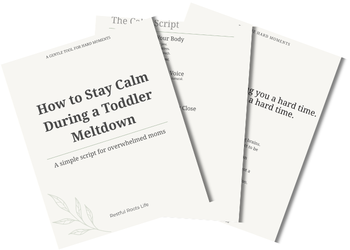
And if your mind tends to go blank in the middle of a meltdown, I created a simple printable guide — How to Stay Calm During a Toddler Meltdown — with a step-by-step script you can keep on your phone or fridge
2. Get Low and Stay Close
Kneel down. Lower your body. Stay nearby.
You don’t have to fix it — just anchor it.
3. Name the Feeling
“You’re really upset.”
“You didn’t want that.”
“This feels big.”
Sometimes having a simple visual tool like a feelings chart or flipbook can help toddlers understand what they’re feeling and what they can do next, especially in the middle of a meltdown.
You don’t have to agree with the behavior to validate the emotion.
4. Offer Simple, Limited Choices
Too many options overwhelm. But one small choice restores control:
“Do you want the green cup or the yellow cup?”
“Do you want to hop to the car or tiptoe?”
“Should we hold hands or should I carry you?”
You’re not giving in.
You’re giving structure inside the emotion.
5. Reconnect After the Storm
Once breathing slows:
A hug.
A soft voice.
“I’m here.”
No lectures. Just connection.
Creating a Calm-Down Space at Home
One of the most practical ways to handle toddler tantrums is to prepare before they happen.
Not as punishment.
But as a supportive reset space.
A soft rug.
A small basket.
A quiet corner.
You might include:
But remember — it doesn’t have to be elaborate. Emotional safety matters more than aesthetics.
because so much of this work isn’t visible, but it shapes everything.
When Tantrums Feel Constant — And You’re Burned Out
There’s something especially heavy about tantrums when they feel daily.
The constant noise.
The constant needs.
The constant decision-making.
Parenting stretched my capacity in ways I didn’t expect — especially raising twins. I shared more about that in What Parenting Twins Has Taught Me About Capacity, because sometimes the hardest part isn’t the tantrum. It’s realizing how thin you’re already stretched.
If overstimulation is something you’re quietly battling, you might also relate to
You Don’t Need to Be Calm — You Need to Be Regulated
You cannot co-regulate well if you are chronically dysregulated.
Your care matters too.
Some days the goal isn’t thriving.
It’s staying steady.
And that is enough.
Connection Over Control
Toddler tantrums are not proof that you’re failing.
They are proof your child is learning how to handle big feelings in a very small body.
And you are learning too.
Each time you choose connection over control, you are teaching your child:
Big feelings don’t scare you.
Hard moments don’t make you unlovable.
And even when things feel overwhelming — we stay.
Your child isn’t giving you a hard time.
They’re having a hard time.
You are allowed to be learning too.
One steady day at a time,
Jen