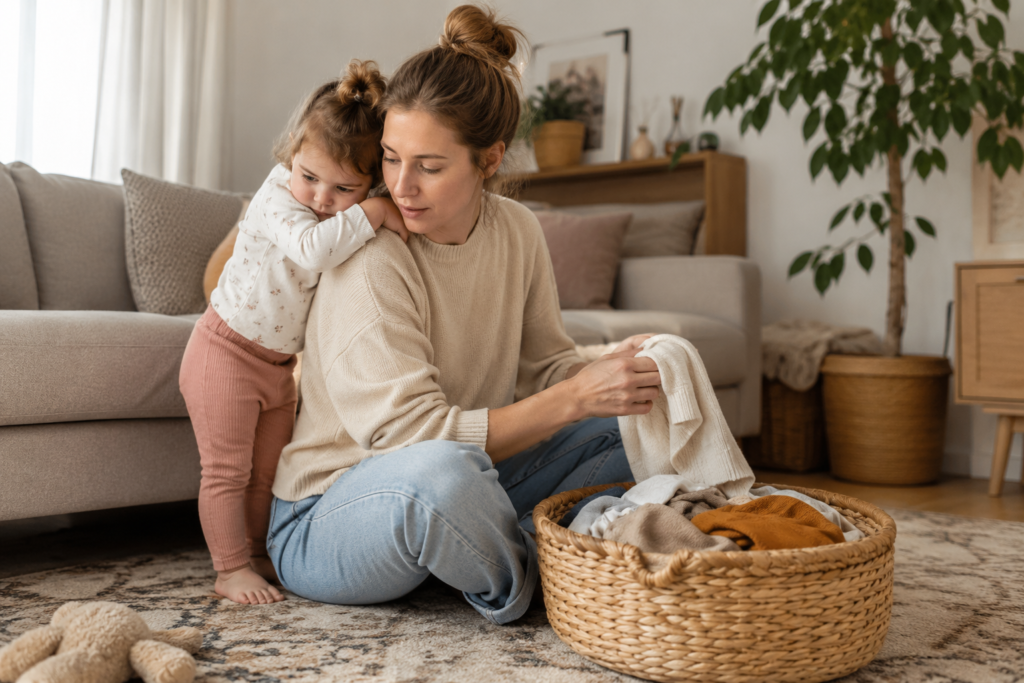
If you’re reading this while your toddler is wrapped around your leg asking you to watch them jump off the couch for the fifteenth time, welcome. You’re in good company.
I used to wonder if I was doing something wrong.
I’d hear other moms talk about folding laundry while their toddlers happily played nearby, and meanwhile, I couldn’t unload the dishwasher without answering seventeen questions, finding a missing stuffed animal, or being invited to admire another block tower masterpiece.
I desperately wanted just ten uninterrupted minutes.
So I started asking myself the same question many parents quietly wonder:
Why won’t my toddler play alone?
The answer surprised me.
The Truth About Independent Play
Toddlers aren’t wired for long stretches of independent play.
They’re learning about the world through connection. They look to us for reassurance, interaction, and shared experiences. In many ways, wanting you nearby isn’t a sign that something is wrong. It’s a sign that your child feels safe enough to seek you out.
That doesn’t mean it isn’t exhausting.
Especially when you’re trying to make lunch, answer emails, care for another child, or simply hear yourself think.
Why Your Toddler Wants You All the Time
There are a few reasons toddlers struggle with independent play:
-
They crave connection and attention.
-
They don’t yet have a long attention span.
-
They may not know how to initiate play on their own.
-
Big developmental leaps can increase clinginess.
-
Changes in routine, sleep, or stress can make them seek extra reassurance.
Sometimes, we expect toddlers to play independently for longer than they’re developmentally ready to manage.
And if your toddler’s need for connection sometimes shows up as big emotions, protests, or complete meltdowns, you’re not alone. I share practical, gentle strategies in my post, How to Handle Toddler Tantrums Without Yelling (Even on the Hard Days), to help you navigate those overwhelming moments with more confidence and less guilt.
That realization helped me shift my expectations.
Instead of asking, “Why can’t they just play by themselves?” I started asking, “How can I support this skill over time?”
Independent Play Is a Skill
The biggest mindset shift for me was realizing that independent play isn’t a personality trait.
It’s a skill.
Some toddlers naturally gravitate toward it. Others need more guidance and practice.
That doesn’t mean they’ll always need you every second of the day.
Like any skill, it develops gradually.
Gentle Ways to Encourage Independent Play
Start small.
If your toddler usually needs you beside them constantly, don’t expect thirty minutes alone tomorrow.
Begin with five minutes.
Sit nearby while they play. Narrate what you notice.
“You built a tall tower.”
“You found all the blue cars.”
Then slowly create a little space.
“I’ll be right here folding towels while you keep playing.”
Simple invitations also help:
-
Set out open-ended toys without instructions.
-
Rotate toys so fewer choices feel overwhelming.
-
Create predictable moments of independent play each day.
-
Resist the urge to direct every part of their play.
Most importantly, reconnect afterward.
A few minutes of focused attention can often fill their connection cup enough to make short periods of independent play feel safer.
A Reminder for the Mom Who Feels Touched Out
If your toddler only wants you right now, it doesn’t mean you’re spoiling them.
It doesn’t mean you’ve created a bad habit.
It doesn’t mean they’ll still be asking you to admire every crayon scribble when they’re sixteen.
It means they’re little.
It means you’re their safe place.
And while it’s okay to need space, it’s also okay if independent play hasn’t clicked yet.
If you’re finding yourself caught between wanting to meet your toddler’s need for connection and desperately needing a little space of your own, my Calm Boundaries, Connected Kids printable guide offers practical scripts and gentle strategies to help you set loving limits without losing your cool. It’s the resource I wish I’d had during those clingy, exhausting seasons of motherhood.
Some seasons of motherhood are more hands-on than others.
This won’t last forever.
One day, you’ll miss being invited into their imaginary worlds quite this often.
For now, celebrate the small wins.
Five minutes becomes ten.
Ten becomes fifteen.
And little by little, both of you learn that it’s okay to be close while also growing more independent.
If your toddler won’t play alone today, take a deep breath.
You’re not failing.
You’re simply raising a child who’s learning how to explore the world—and who still feels safest knowing you’re nearby.
One steady day at a time.
Jen