

A realistic, no‑perfection guide to syncing their day without losing your mind
If you’re trying to get your twins on the same schedule and it feels impossible… you’re not doing it wrong.
You’re just doing something that is hard.
Because syncing two tiny humans with different needs, moods, and energy levels? That’s not a gentle parenting moment. That’s logistics, survival, and a whole lot of trial and error.
But here’s the good news: You don’t need a perfect routine. You just need a repeatable rhythm.
If you’ve been searching for how to get twins on the same schedule and nothing seems to work, this approach focuses on rhythm over rigid routines.
Why Getting Twins on the Same Schedule Actually Makes Life Easier
Having twins on different schedules might sound manageable… until you’re feeding one while the other wakes up, putting one down while the other melts down, and never sitting down. Ever.
Getting them aligned isn’t about control. It’s about giving yourself breathing room.
A note on age: This approach works best from the early weeks up to around six months. Once they start solids or drop naps, you will adapt, but the rhythm principle still holds.
The Biggest Mistake Parents Make When Trying to Sync Twins
Trying to follow a perfect schedule from the internet. Rigid schedules break fast with twins.
Instead of forcing exact times, focus on this: anchor your day around events, not the clock.
How to Get Twins on the Same Schedule
Step 1: Wake Them Up Together. Yes, Really.
Even if one twin is still sleeping… wake them.
I know it feels wrong. But this is the foundation of everything. Same wake time means same feed time. Same feed time means same nap window. Same nap window means a synced day.
If you do not start together, you will spend the whole day playing catch-up.
And that’s where the burnout starts.
And yes, waking a peaceful baby feels criminal. But with twins, never wake a sleeping baby is a singleton rule. For twins, a few days of waking the sleeper gives you weeks of better rest for everyone. They will adjust.
Step 2: Feed at the Same Time
Even if one twin does not seem hungry yet.
Bottle feed? Feed simultaneously. Breastfeeding? Alternate or tandem if possible.
Tandem feeding without losing your mind:
For bottles, use prop pillows, a twin feeding pillow, or sit criss-cross on the floor.
For breastfeeding, try the football hold with a twin nursing pillow, or feed one then the other and swap sides each feed.
If tandem is impossible, feed the hungrier one first, then the other, but keep the second feed within fifteen minutes so wake windows stay close.
You are not just feeding. You are training their internal rhythm.
Overnight: feed them together even if only one twin wakes. Otherwise you will be up twice as often. Short-term pain for long-term gain.
Step 3: Sync Naps. This Is Where It Clicks.
This is the hardest part and also the most important.
Watch for wake windows instead of exact times.
Example: Awake for 60 to 90 minutes, then nap.
Put them down together, even if one falls asleep faster and one fusses more. Consistency matters more than perfection.
Short-nap survival: If one twin wakes early from a nap, keep them in a low-stimulation environment. Dim room, no play. Wait until the other wakes. Then feed together as usual. This prevents a cascade of off-schedule feeds.
When Both Twins Wake Up Crying…
If this is the part that breaks you, you’re not alone.
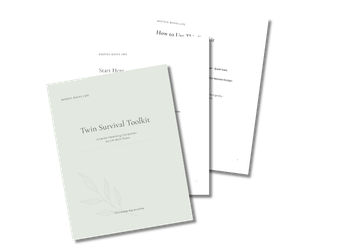
I created a 7 page Twin Survival Toolkit—a simple, step-by-step system you can follow in real time when both kids need you and everything feels like too much.
Because in those moments, you don’t need more advice.
You need something to hold onto.
When Both Twins Need You at Once, Start Here
When everything feels like it’s happening at the same time—crying, needs, noise, overwhelm—your brain isn’t failing. It’s overloaded. The Twin Survival Toolkit gives you a simple way to respond in the moment without freezing or spiraling. Just clear steps, calming scripts, and a system you can actually use when things feel chaotic.
Step 4: Reset at the Next Wake Window
Bad nap? One twin skipped it? Do not spiral.
Reset at the next cycle. Wake together again. Feed together again. Try again next nap.
Twin life is less about control and more about constant gentle resets.
Step 5: Lower the Pressure. This Is the Secret.
Some days will not sync. Some days will fall apart by 10 a.m.
That does not mean it is not working. It means you are raising twins.
A Realistic Daily Schedule for Twins (Simple + Flexible)
Not perfect. Just functional.
Morning
7:00 a.m. – wake and feed
8:30 a.m. – nap (after about 90 minutes awake)
Midday
10:00 a.m. – wake and feed
11:30 a.m. – nap
Afternoon
1:00 p.m. – wake and feed
2:30 p.m. – nap
Evening
4:00 p.m. – wake and feed
Short catnap if needed
Bedtime routine together
When It Feels Overwhelming
Because it will. Especially when both are crying, both are tired, and you are touched out, overstimulated, and running on empty.
This is where most advice stops. But this is where you actually need support.
That’s exactly why I created my Calm Reset Guide for Moms—
a simple, in-the-moment script you can follow when both kids need you and your brain feels like it’s about to short-circuit.
Because in those moments, you don’t need more advice.
You need something to hold onto.
What About a Partner or Helper?
If you have a partner or helper, divide and conquer during the rough patches. One handles the fussy twin while the other keeps the calm twin on rhythm. Then swap.
What If One Twin Has a Medical Need?
If one twin has reflux, colic, or another medical issue, syncing may not be possible right away. In that case, focus on protecting your own sanity first. Get help, stagger care, and revisit sync when things stabilize.
Emergency Sync Reset
When everything falls apart, use this checklist:
Both fed? If not, feed the hungrier twin first, then the other within fifteen minutes.
Both changed? Do a double diaper check.
Both tired? Watch for yawns or eye rubbing, then put them down together regardless of the clock.
Still chaos? Abandon sync for one cycle. Let them nap separately, then restart at the next wake window.
Looking for More Twin Support?
You do not need to figure this all out alone. Sometimes a simple tool makes the difference between surviving and feeling like you have a plan.
Here are a few low‑cost, low‑pressure resources I created for twin parents just like you.
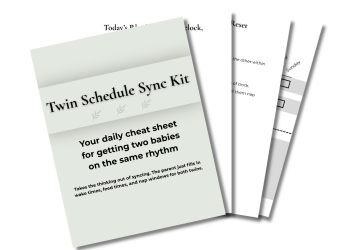
$3 – Twin Schedule Sync Kit
This printable pairs directly with the blog post you just read.
It gives you a daily side‑by‑side tracker for both twins, an emergency sync reset checklist, wake windows by age, and a weekly sync scorecard. Print it, fill it out, and stop guessing.
A Simple Way to Get Your Twins Back on Track
When your schedule starts to fall apart and nothing is lining up, it’s easy to feel like you’re constantly playing catch-up. The Twin Schedule Sync Kit gives you a clear, simple way to reset your day—without overthinking every nap, feed, or wake window. Use it to track both twins side-by-side, reset when things go off track, and build a rhythm that actually works in real life.
$7 – Twin Survival Toolkit
A 7‑page printable system for those moments when both twins need you at once and your brain goes blank. Includes in‑the‑moment scripts, a quick‑view decision flow, an after‑the‑storm reflection page, and an end‑of‑day reset. Designed for real chaos, not perfect parenting.
KDP – The Toddler Twin Survival Map
A calm, practical guide for parenting toddler twins without losing yourself in the chaos. Perfect for when you have graduated from the newborn schedule stage and need help navigating meltdowns, boundaries, and the mental load of two. Available on Amazon.
No pressure. No complicated systems. Just one clear next step when you are ready.
Quick Recap: Twins Same Schedule Tips
Wake them at the same time
Feed them at the same time
Put them down for naps together
Reset when things go off track
Focus on rhythm, not perfection
Final Thought
Learning how to get twins on the same schedule takes time, but small, consistent steps make a big difference.
Getting your twins on the same schedule is not about doing it perfectly. It is about making your day just a little more manageable.
And if today did not go how you planned?
You get to reset tomorrow.
One steady day at a time
Jen