

Night Weaning Without Tears Yours or Theirs
There comes a point—usually in the middle of the night, when you’re completely exhausted—when you start to wonder:
“Do they still need this… or is this just habit now?”
Night weaning isn’t just about sleep.
It’s about emotions. Attachment. Guilt. Survival.
And if you’ve ever laid there after a night waking, staring at the ceiling, questioning everything—you are not alone.
A Quick Welcome
Whether you’re brand new here or have been walking this parenting journey with me for a while—I’m really glad you’re here.
This space is all about real-life parenting, emotional regulation, and finding calm in the chaos… even at 2 a.m.
What Night Weaning Actually Is
Let’s clear this up first—because there’s a lot of confusion around it.
Night weaning is not:
Ignoring your child
Forcing independence
Leaving them to cry it out
It is:
Gently reducing or eliminating night feeds
Supporting your child as they learn a new rhythm
Staying connected while setting new boundaries
Night weaning isn’t about pushing your child away—it’s about guiding them forward.
When Is the “Right Time”?
This is where most parents get stuck.
You’ll hear all kinds of timelines—6 months, 9 months, 12 months—but the truth is:
There is no perfect, universal moment.
Some signs your child might be ready:
They’re eating well during the day
Night feeds are very short or more like “snacks”
They wake at predictable times out of habit
But here’s the part that matters just as much:
Your readiness matters too.
If you are completely depleted, touched out, and running on empty—that’s part of the equation. You don’t have to wait until you’re at your breaking point to make a change.
What the Journey Really Feels Like
No one talks about this part enough.
Night weaning can feel… emotional.
You might:
Second-guess yourself constantly
Feel guilty saying no at night
Worry you’re damaging attachment
Go back and forth night to night
Some nights you’ll feel confident.
Other nights, at 2 a.m., you’ll do what’s easiest just to survive.
That doesn’t mean you’re doing it wrong.
That is the process.
Gentle Ways to Night Wean
There isn’t one “right” way to do this. The best approach is the one that feels sustainable for you and supportive for your child.
1. Gradual Reduction
Slowly reduce the amount of milk over time:
Shorten nursing sessions
Decrease ounces in a bottle
Stretch time between feeds
This is one of the gentlest ways to ease the transition.
2. Pause Before Feeding
When your child wakes:
Wait a moment before immediately feeding
Offer comfort first (voice, touch, presence)
Sometimes they just need reassurance—not milk.
3. Set a Loving Boundary
You can begin introducing a simple, consistent message:
“Milk is going to sleep at night. I’m still here with you.”
You’re not removing comfort—you’re just changing how it looks.
A Gentle Reminder You Might Need
Your child isn’t giving you a hard time.
They’re having a hard time.
Night weaning can feel big for them—and for you.
You can hold the boundary and hold your child.
A Little Support for the Hard Moments
If you’re in the middle of night wakings and not quite sure what to say—or how to stay calm when it feels hard—I created something simple to support you in those moments.
The Night Weaning Calm Plan (Free Printable)
This gentle guide walks you through:
What to say during night wakings
How to hold the boundary without disconnecting
Simple, realistic steps you can follow—even when you’re exhausted
It’s designed for those 2am moments when everything feels heavier and harder.
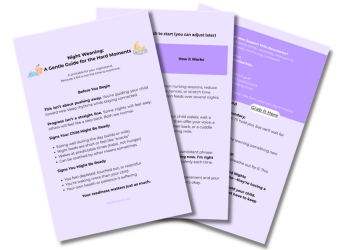
The Night Weaning Calm Plan
If You Want Deeper Support
If holding this boundary feels harder than you expected—you’re not alone.
This is where so many parents get stuck.
Not because they don’t know what to do… but because it’s hard to stay calm and consistent in the moment.
That’s exactly why I created:
Calm Boundaries, Connected Kids
This printable helps you:
Set clear, loving boundaries without guilt
Stay calm when your child pushes back
Build connection while holding the limit
It’s designed for real-life moments—like night wakings, big emotions, and everything in between.
It’s something you can come back to again and again—especially on the nights that feel the hardest.
What This Might Look Like (Real Life)
Some nights will go smoothly.
Some nights won’t.
You might make progress… and then hit a rough patch.
You might feel confident… and then question everything again.
That doesn’t mean it isn’t working.
It means you’re in it.
Final Thoughts
Night weaning isn’t a straight line.
It’s a series of small steps, setbacks, and quiet wins that no one else sees.
You’re not doing it wrong.
You’re not behind.
You’re learning your child—one night at a time.
And that matters more than any “perfect” plan ever could.
One steady day at a time.
Jen