“This post may contain affiliate links, which means I may earn a small commission (at no extra cost to you). I only share what I truly love!”
If you have a toddler at home, you’ve probably noticed that their favorite “toys” aren’t always the ones in the toy box. Sometimes it’s the pots and pans, the crinkly paper, or the box of dry pasta.
That curiosity isn’t just mess-making—it’s science. It’s called sensory play, and it’s one of the most powerful ways toddlers explore the world.
In this post, we’ll cover why sensory play is so crucial for your toddler’s development, how to set it up without losing your mind, and what you can make with 3 simple DIY recipes. Plus, grab our free printable guide with even more recipes and a sensory bin starter kit!
—
Part 1: Why Sensory Play for Toddlers Matters. The Key Benefits.
For a toddler, the world is a brand new place. They don’t yet have the language to ask, “What does this feel like?” or “How does this material move?” Instead, they dig their hands in, dump it out, and do it again.
Sensory play is any activity that stimulates a child’s senses: touch, smell, sight, hearing, and taste. For toddlers specifically, the benefits are immense:
· Brain Development: Sensory play builds neural pathways. When a toddler squishes playdough, their brain is working on problem-solving, memory, and processing sensory input.
· Language Skills: It sparks rich conversation. Instead of just “good job,” you naturally start using descriptive words like squishy, grainy, cold, and heavy.
· Fine Motor Skills: Scooping, pinching, and pouring strengthen the small muscles in their hands that will later be used for holding a pencil and using scissors.
· Self-Regulation: Sensory activities have a calming effect. A sensory bin can help a toddler process big emotions and find a moment of focus—a skill often called “creative mindfulness.”
“Simple, predictable activities like this are why toddlers thrive on routine—read more about the power of “boring” routines here.”
· Curiosity & Exploration: It allows toddlers to take the lead. There is no “right” way to play with a sensory bin, which builds confidence and independent thinking.
—
Part 2: How to Set Up Sensory Play for Toddlers (Without the Stress)
Let’s be honest: the idea of sensory play can feel intimidating. The mess, the set-up, the cleanup. “If this feels overwhelming at times, you’re not alone—especially if you’re parenting more than one little one. You can read more about the invisible mental load here.”But with a few simple strategies, it can become a staple of your week without causing stress.
1. Embrace the “Yes” Space: Set up a specific area where mess is allowed. A kitchen floor (easy to sweep), a plastic tablecloth on the carpet, or a high chair tray are all great options.
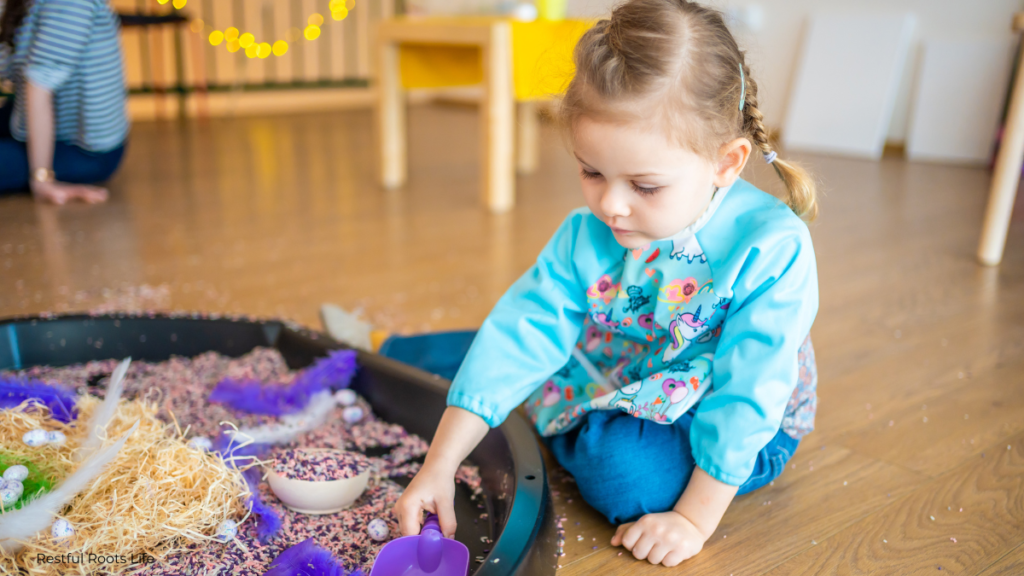
2. Use a Sensory Bin: A shallow plastic storage tub or a baking dish defines the space. It contains the chaos and makes cleanup simple. Here’s the sensory bins I use.
3. Start Small: You don’t need a huge setup. Sometimes 15 minutes of play is all a toddler has the attention span for.
4. Supervise, Don’t Direct: Your job is to set it up and sit nearby. Let them lead. If they want to dump everything out, that’s part of the exploration (just set a boundary that we scoop it back up together).
5. Rotate to Keep It Fresh: You don’t need to do sensory play every day. Keep 2–3 bins in rotation and swap them out weekly to keep things novel.
—
Part 3: 3 Easy Sensory Play Recipes for Toddlers (Taste-Safe & Simple)
These recipes use ingredients you likely already have in your pantry. They are taste-safe, meaning if a curious toddler sneaks a handful, you don’t need to panic (though none are meant to be eaten as a meal).
—
1. Taste-Safe Cloud Dough
This is the silkiest, softest sensory material. It feels like a cloud and molds just like sand.
Ingredient Amount
Flour 1 cup
Baby oil (or vegetable oil) ¼ cup
Instructions: Mix until crumbly. Add more oil for a wetter texture or more flour for a drier texture.
Sensory Focus: Touch (soft, silky, moldable)
Mess Level: ★★☆☆☆
Shelf Life: 2–3 weeks in an airtight container
Bonus: Add cocoa powder for a chocolate scent (and color)!
—
2. Simple Oobleck (The Solid-Liquid)
This non-Newtonian fluid is magic for toddlers. It acts like a solid when you squeeze it and a liquid when you let it go.
Ingredient Amount
Cornstarch 2 cups
Water 1 cup
Instructions: Mix until it feels like a thick paste. Add a drop of food coloring if desired.
Sensory Focus: Touch (slimy, runny, firm)
Mess Level: ★★★☆☆
Shelf Life: Discard after use (does not keep)
—
3. Scented Playdough (No-Cook)
Store-bought is fine, but homemade is softer and lasts longer. This no-cook version takes 5 minutes.
Ingredient Amount
Flour 1 cup
Salt ½ cup
Cream of tartar 2 tsp
Oil 1 tbsp
Boiling water ½ cup
Food coloring Few drops
Extract (vanilla, lemon, peppermint, etc.) Few drops
Instructions: Mix dry ingredients. Add oil, coloring, and extract to the boiling water. Pour into dry mix and stir until it forms a dough. Knead until smooth.
Sensory Focus: Touch (soft, moldable) + Smell
Mess Level: ★☆☆☆☆
Shelf Life: 3–6 months in an airtight container
—
Part 4:Ready for More Sensory Play Ideas for Toddlers?
These 3 recipes are just the beginning. Sensory play opens up a world of exploration for your toddler—from rainbow rice to gelatin excavations to seasonal themes.
If you’re ready to build your sensory play toolkit, I’ve got something for you:
Grab the free Sensory Play Cheat Sheet!
You’ll get:
· All 3 recipes from this post in a quick-reference format
· 2 bonus recipes not found in this post
· A sensory bin starter kit (containers, tools, bases, and add-ins)
—
Sensory play doesn’t have to be complicated, expensive, or perfectly Instagram-worthy. Sometimes, the best sensory activity is a bowl of water and a few measuring cups on the kitchen floor.
If you’re ready for more support beyond sensory play, my Calm Boundaries, Connected Kids guide gives you the exact words to say, how to handle pushback, and how to repair when things don’t go perfectly—all in a simple 27-page printable.
Just remember…the goal is connection and exploration. Your toddler isn’t just making a mess—they’re building a brain.
So, take a deep breath, grab a bin, and give one of these recipes a try. Let the squishing, scooping, and discovering begin!
One steady day at a time
Jen
—